A failed inspection is not a fine and it is not a disaster. It is a list, and there is a fourteen day window built into the system for dealing with it. Knowing that changes how the whole thing feels.
The short version
- Most light vehicles more than five years old need a yearly safety inspection report before registration can be renewed.
- The five year exemption runs from the month and year on the compliance plate, not from when you bought the car.
- A report is valid for six months, so it must be used to renew registration inside that window.
- Only an Authorised Inspection Scheme station can perform the check. A mobile mechanic cannot issue one.
- Repairs completed within 14 days and reassessed at the same station attract no extra inspection fee.
What the rule actually is
In New South Wales the safety inspection everyone calls a pink slip is formally an eSafety check, and the result goes to Transport for NSW electronically rather than to you on paper. The rule itself is short. Transport for NSW states that most light vehicles more than 5 years old need a yearly safety inspection report before registration can be renewed.
The five year exemption is calculated from the month and year on the vehicle's compliance plate. For an imported vehicle it runs from the month and year of manufacture. It is not measured from the day you bought it, which catches out people who buy a four year old car and assume they have four more years to go.
The report is then valid for six months. You have to use it to renew the registration inside that window, or it expires and you pay for another one. Getting the check done early is sensible. Getting it done seven months early is money thrown away.
Who is allowed to do it
Only an Authorised Inspection Scheme station can perform the check. That is worth stating plainly because we are a mobile workshop and we cannot issue one, and we would rather you know that from us than find out on the day.
What we can do is the half either side of it: look the car over before it goes in, and do the repairs if it comes back with a list. Those two things are where the time and the money actually sit.
The fourteen day window, which is the useful part
This is the piece most people do not know about, and it changes the arithmetic of a failed inspection completely.
If the vehicle fails and you complete the repairs within 14 days and return it to the same station for reassessment, no extra inspection fee applies. Go past the 14 days, or take it somewhere else, and you pay for another full inspection.
So a fail is a clock starting, not a wall. Two weeks is enough time to get parts and get the work done, provided you start on it rather than leaving the report on the passenger seat.
Where a mobile mechanic fits this
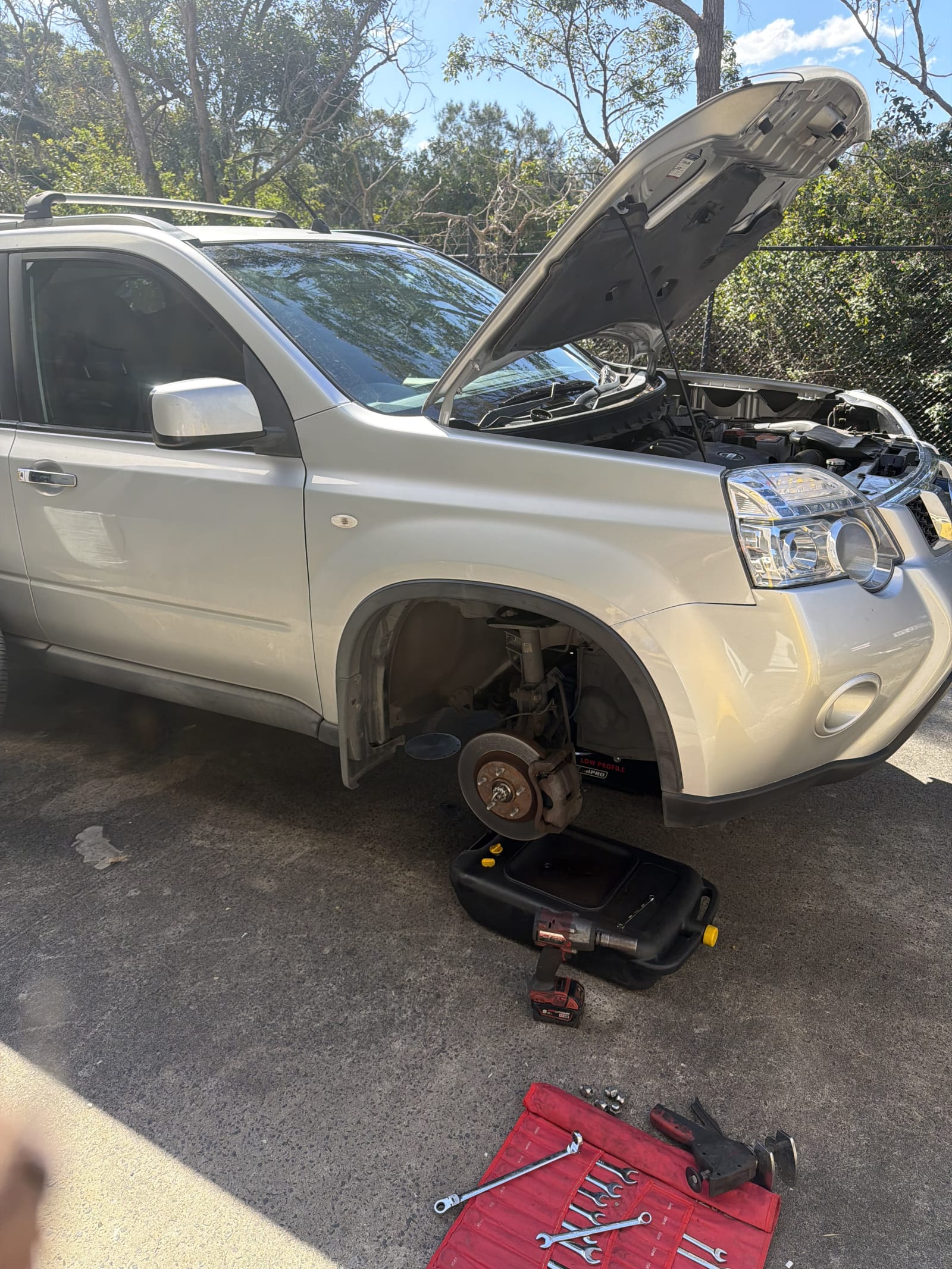
Awkwardly well, as it happens. The failure list is usually brakes, tyres, lights or wipers, which is exactly the work that does not need a hoist and a workshop. We can do it in the driveway at Terrigal or the car park at Erina, inside the window, and you drive back to the same station rather than organising two more trips.
What fails most often, and why
Inspection outcomes are not mysterious. The same handful of items account for most failures, and every one of them is visible weeks in advance to anyone who looks.
Tyres
The most common single cause. The legal minimum tread depth in New South Wales is 1.5 mm, measured across the tread, and plenty of tyres sit just above it for months without the owner realising. Tread is only half of it though. Uneven wear, sidewall damage, cracking from age, mismatched sizes across an axle and incorrect speed ratings all fail as well.
Age matters more here than most people expect. Rubber perishes in UV and salt air, and a tyre on a car parked outside at Copacabana ages faster than the same tyre in a garage inland. A tyre with plenty of tread can still fail on cracking alone.
Brakes
Thin pads are the obvious one. The less obvious ones are what tend to catch coastal cars: a seized calliper, a leaking wheel cylinder, a perished flexible hose, a scored or badly worn disc, or a park brake that no longer holds properly.
Corrosion drives most of that. Damp air and salt work on slide pins, cable housings and hose fittings, which is one of the reasons a coastal car needs its brake hardware looked at rather than just its pad thickness measured. There is more on why in what the climate here does to a car.
Lights, wipers and glass
Cheap to fix, and responsible for a lot of avoidable fails. A blown globe, a number plate light nobody has looked at in years, wiper blades that smear, or a windscreen crack in the driver's line of sight. Every one of those is a five minute check in your own driveway before you book anything.
Steering, suspension and leaks
Excessive play in the steering, worn ball joints or bushes, a torn CV boot, and visible fluid leaks all appear on failure lists. A leak is the one worth acting on quickly regardless of the inspection, because whatever is leaking out is not doing its job inside.
Getting it looked at before it goes in
There is an obvious asymmetry in how a pink slip works. The inspection tells you what is wrong, but only after you have paid for it and only in the format of a fail. Nothing stops you finding out first.
A pre-inspection check is the same list of items, looked at without the paperwork attached. Brakes off the car, tread depths measured rather than eyeballed, every lamp tested, play checked at the wheel, and a look underneath for leaks and perished rubber. It takes about an hour on most cars.
The value is not that it is cheaper than failing. It is that it removes the deadline. Find a seized calliper in your own time and you order the part and book the work when it suits. Find it on a failure report and you are inside a fourteen day window, competing with everyone else who also failed that week.
When it is worth doing and when it is not
On a car that has been serviced on schedule and driven gently, it is usually money you did not need to spend. The service was already looking at most of those items.
It earns its keep on a car that has missed a service or two, on anything bought privately where you do not know the history, and on a car that lives outside near the water where the corrosion items move faster than the wear items. On the last of those, the failure is rarely the pads.
What to check yourself before you book
Fifteen minutes on a Saturday will catch most of the cheap failures and save you a second trip.
Walk around the car with the lights on and the hazards going, and get someone to press the brake pedal while you look at the rear. Check every globe including the number plate and the reverse lights. Run the wipers on a wet screen and see whether they clear it or smear it.
Look at the tyres properly. Tread depth indicators sit in the grooves, and if the tread is level with them the tyre is finished. Check the inner shoulder as well as the outer, because uneven wear from alignment hides on the side you cannot see. Look for cracking in the sidewall.
Then check under the car for drips on the driveway, and look at the windscreen from the driver's seat rather than from outside. A chip that is invisible standing in front of the car can sit squarely in your line of sight when you are behind the wheel.
One last thing worth knowing about the walkaround. Do it in daylight and do it with the car cold, parked where you can see the ground underneath. A leak that has had all night to drip leaves a mark you cannot miss, and the same leak an hour after a drive has usually burnt off the hot components and left nothing to find.
What happens between the report and the renewal
The two things are separate steps and people routinely treat them as one. Passing the check does not renew anything. It only makes the renewal possible.
The station lodges the result electronically with Transport for NSW rather than handing you a slip to post. That is the whole reason it is called an eSafety check now, and it means there is nothing for you to carry anywhere. What you do still have to do is pay the registration.
The six month validity is the part to plan around. A report issued today is usable for six months, so booking the check a fortnight or so ahead of the expiry gives you room for a fail and a repair without running the clock out. Booking it the day before expiry gives you none, and a fail on that day means the registration lapses while the car is being fixed.
It also cuts the other way. Getting the check done far too early wastes it: if the registration is not renewed inside the six months the report expires and the next one is a new fee. There is no benefit to being nine months early and there is a real cost.
For a car that has been off the road, or one bought privately with the registration already expired, the sequence is different again and worth confirming with Service NSW before booking anything, because an expired registration can require a different inspection rather than a standard safety check.
Where to start
Find your compliance plate date and your registration expiry. If the car is over five years old, the Service NSW page on safety inspection reports sets out how the check and the renewal fit together.
Do the fifteen minute walkaround first. If it turns up worn tyres, a soft pedal or a leak, get that sorted before the inspection rather than after, because a pass first time is one trip instead of three.
If the car has already failed, the fourteen days start from the inspection. We do mechanical repairs and servicing across the Central Coast, we come to the car, and we can usually work inside that window. Licence MVTC182392. Get in touch and tell us what is on the list.