Your logbook gives you a distance and a time, and most people watch the distance. On the Central Coast the time is usually the one that runs out first, and the reason is in the way we drive here rather than in the car.
The short version
- Every logbook carries two limits, a distance and a time, and the service is due at whichever arrives first.
- Oil degrades on a calendar, not on an odometer, so a car doing 5,000 km a year still needs servicing on schedule.
- Most manufacturers publish a second, shorter schedule for severe conditions. Short trips and sustained hill work both qualify.
- Narara Research Station recorded a mean 9am relative humidity of 74 per cent across its record, and 84 per cent in March.
- A short trip never gets the oil hot enough to boil off the water and fuel that condense into it.
What the logbook actually says, and what people read
Open the service schedule in any owner's manual and you will find two numbers against each interval. One is a distance. The other is a period of time. The sentence joining them is almost always "whichever occurs first", and that phrase is doing more work than any other line in the book.
People read the distance. It is the number on the dashboard, it goes up when you drive, and it feels like the thing that measures wear. The time limit sits in the same table and gets skipped, because nothing in the car counts it for you.
That is the single most common reason a car arrives for a service with oil that should have come out months earlier. The owner has done nothing wrong by their own reckoning. They have watched the wrong number.
Why oil ages when the car is parked
Engine oil is not just a lubricant being slowly worn away. It is a chemistry package, and the additives in it deplete whether or not the engine is running. Detergents that hold soot in suspension get used up. The anti-oxidants that stop the base oil thickening get consumed. Acids from combustion stay in the sump and keep working on bearing surfaces.
A car that sits in a carport in Erina for three weeks between drives is not resting. The oil in it is quietly getting worse, and the odometer has no opinion about that at all.
Short trips are harder on an engine than long ones
This is the part that surprises people, because it runs against intuition. A ten minute drive feels gentler on a car than an hour on the M1. For the oil, it is the opposite.
Combustion produces water. A lot of it. On a cold start that water condenses on cold cylinder walls and runs past the rings into the sump, along with unburnt fuel. The only thing that removes both is heat: get the oil above about the boiling point of water for long enough and it evaporates back out through the crankcase ventilation.
A short trip never gets there. The engine reaches operating temperature on the coolant gauge long before the oil does, so a drive that ends at the shops has warmed the coolant, warmed the cabin, and left the sump full of the water and fuel it just made.
Do that five days a week and the oil turns into an emulsion that lubricates badly and corrodes steadily. School run, station car park, quick trip into Gosford and back. It is the most ordinary driving pattern there is, and it is genuinely severe duty.
What the Central Coast climate does to a car
The Bureau of Meteorology's Narara Research Station, site 061087, ran from 1916 to 2013 and recorded a mean annual rainfall of 1,328.3 mm over 96 years. The Gosford AWS that replaced it, site 061425, has recorded 1,325.3 mm across its 12 years. Two stations, two eras, three millimetres apart. That is a settled climate, not a run of wet years.
Rain is not really the problem though. Humidity is. Narara's mean 9am relative humidity was 74 per cent annually and 84 per cent through March. Air that damp is a working electrolyte: it condenses on cold metal overnight, sits in seams and connector housings, and keeps corrosion going on surfaces that never get wet in the ordinary sense.
Add salt to it and the rate climbs again. If the car lives within sight of the water at Terrigal, Copacabana or The Entrance, the underbody, the brake hardware and every earth point are working in conditions a car garaged inland never sees.
Where the damp shows up first
Brake calliper slide pins seize. Handbrake cables stiffen. Earth straps corrode until a sensor starts reading rubbish and the dash lights up for no reason you can point at. Battery terminals fur up. None of these are dramatic failures, and all of them are things a service catches while they are still cheap.
Hills put load where flat roads do not
The Coast is not flat. Anyone who has come down off the plateau into Lisarow with a loaded car knows what sustained braking feels like through the pedal, and anyone who has gone back up the other way knows what it does to a gearbox on a hot afternoon.
Descending grades heat brake fluid and transmission fluid in a way suburban flat driving never does. Climbing them holds the engine at high load for minutes at a time, so coolant temperature sits higher and the cooling system spends longer at its limit.
None of that registers as extra kilometres. The odometer counts the same distance whether it was flat and cool or a long climb in traffic, which is another way of saying the odometer is a poor measure of wear.
What the severe conditions schedule is for
Most manufacturers publish a second, shorter schedule alongside the standard one. It is usually headed severe conditions or heavy duty, and the qualifying list is short and specific: repeated short trips, sustained hill work, towing, dusty or unsealed roads, extended idling, and stop start traffic.
Read that list against how the car is actually used here and two or three items usually apply. A tradesman's ute doing suburb to suburb work in Gosford ticks short trips and stop start. A family car that tows a boat to the ramp on weekends ticks towing and hills.
It is not a sales tactic, it is in the book
Worth being clear about this, because the shorter interval sounds like something a mechanic invented to sell more work. It is not. It is printed in the same manual as the standard schedule, by the manufacturer, and on most vehicles it is roughly half the distance or half the time. Check yours before you take anyone's word for it, including ours.
Diesel, petrol and hybrid do not age the same way
The two limits are printed per model, so the book already accounts for most of this. It is still worth knowing why the diesel ute in the driveway and the hybrid beside it are being asked for different things.
A diesel makes soot as a matter of course, and the oil's job is to hold that soot in suspension until it is drained. That is why diesel oil goes black within a few hundred kilometres of a change and why black oil in a diesel is not, on its own, a problem. What is a problem is a diesel doing only short runs. Where a particulate filter is fitted, the engine periodically burns off the soot it has collected, and it needs a sustained drive to do it. Interrupt that halfway often enough and the extra fuel it injects for the burn ends up in the sump, thinning the oil.
The hybrid case, which surprises people
A hybrid's engine starts and stops constantly by design. Over an hour of driving it can accumulate more cold starts and more time below operating temperature than a conventional car does in a week, while the odometer records an ordinary hour.
So the low fuel consumption people expect to mean low wear does not translate to the oil. This is one of the clearest cases where reading the distance instead of the time gets it wrong, and it is why hybrid schedules lean on the time limit.
None of that changes what you do. It changes what you watch: on a short trip diesel and on any hybrid, treat the calendar as the real limit and the odometer as the optimistic one.
The signs that a service is already overdue
Servicing is preventive, so most of the value is in work you never notice. There are still a few things a car does when the interval has been stretched too far, and they are worth knowing.
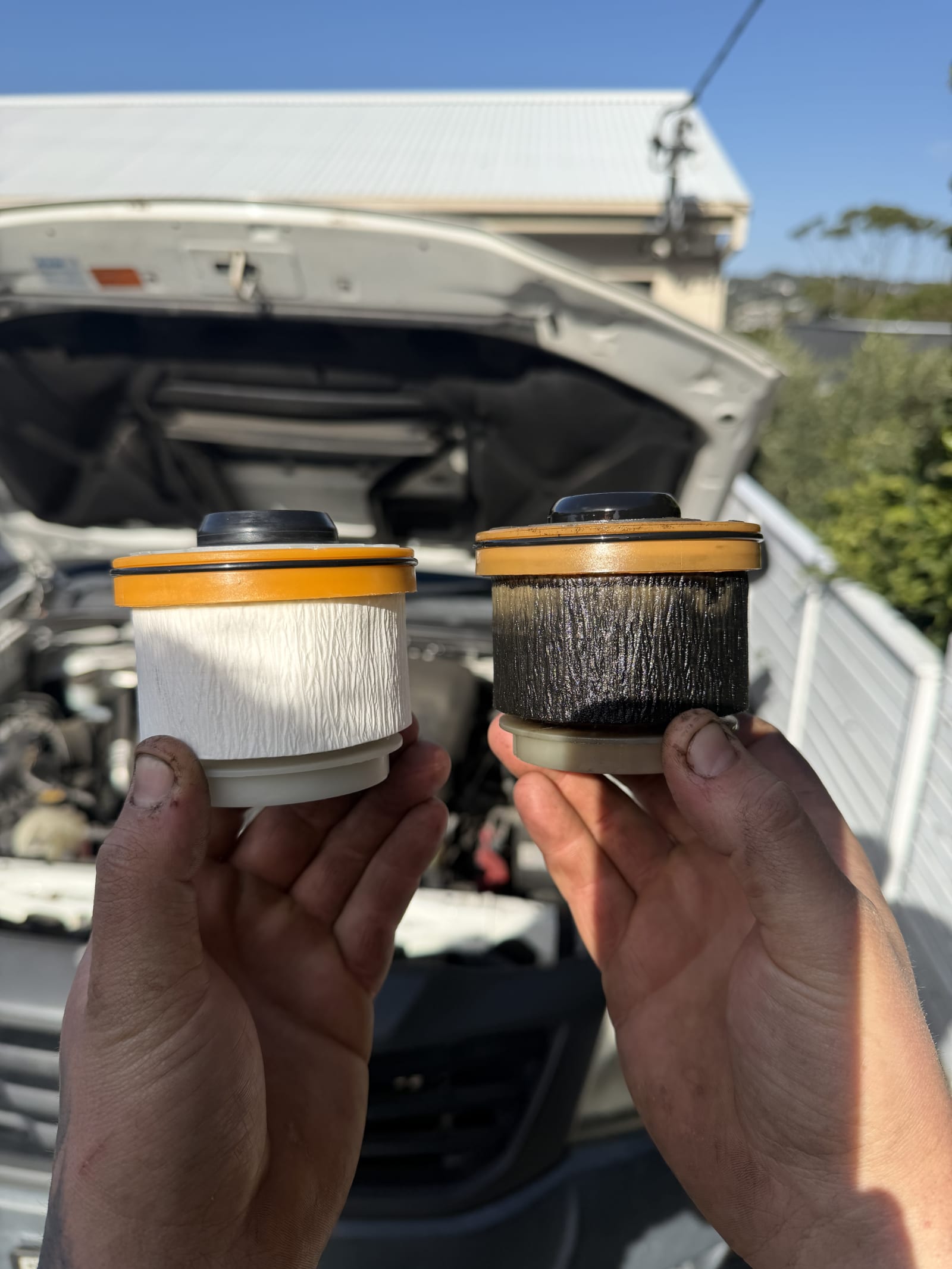
Oil that has gone from amber to opaque black on the dipstick, and stays black straight after a change, is carrying more soot than the detergent package can hold. A milky film under the oil cap on a car that only does short runs is the water problem above, made visible.
A cold start that sounds harsh for the first second or two often means the oil has thinned enough to drain back overnight. A brake pedal that needs a firmer push than it used to, or a handbrake that has to come up two clicks higher, usually means corrosion in the hardware rather than pads on their way out.
If the oil pressure light comes on, stop. Not at the next servo, at the side of the road. Oil starvation ruins bearings in minutes, and it is one of the few faults on a car where the difference between stopping now and stopping in five minutes is the difference between a repair and an engine.
What we look at beyond the oil
A service is not an oil change with a stamp on it. Filters, brake wear and fluid condition, coolant strength, hoses and belts, suspension and steering play, tyre wear pattern, battery condition, and every fluid level that is not sealed for life. On a coastal car the corrosion check matters as much as any of it, which is why we do not skip it.
Where to start
Find the last service date and the odometer reading at that service. They are on the sticker in the windscreen or in the logbook. Then find the two limits for your next interval in the manual, and work out which one arrives first. On most Central Coast cars it is the time.
If the interval has passed, book a service. If the car is still under warranty, a logbook service keeps the schedule intact, and there is more on how that works in what the law says about servicing outside the dealership.
We are a mobile workshop, so the car stays where it is and you keep your day. We cover the Central Coast from Lisarow and Ourimbah through to Woy Woy and The Entrance. Licence MVTC182392. Get in touch and we will find a time.