The belief that a new car has to go back to the dealer or the warranty dies is the most expensive myth in Australian motoring. It is also wrong, and it has been wrong in writing for years.
The short version
- Consumer guarantees under Australian Consumer Law apply no matter who services the car, and cannot be excluded by a warranty's wording.
- The ACCC has told manufacturers to remove logbook statements implying servicing must be done by an authorised dealer when no such condition exists.
- Three things must be true: a qualified person, parts suitable for the vehicle, and the manufacturer's own schedule and specifications.
- Since 1 July 2022 manufacturers must sell service and repair information to any Australian repairer at no more than fair market value.
- A manufacturer warranty is a separate, voluntary promise, and some do require their own dealer network for a repair claimed under it.
The claim, and where it comes from
Somewhere in the first month of owning a new car, almost everybody is told the same thing. Take it anywhere but the dealer and you lose your warranty. It is usually said with complete confidence, sometimes by the person selling the car, and it changes where people spend money for the next five years.
It is not true, and it has not been true for a long time. What is true is more useful and slightly more detailed, so it is worth setting out properly rather than just contradicting the myth.
Two different things, often confused
A new car comes with two separate sets of rights, and mixing them up is where most of the confusion starts.
Consumer guarantees are automatic. They come from Australian Consumer Law, they apply to the car whether anyone mentions them or not, and a business cannot exclude, restrict or modify them. A manufacturer warranty is different: it is a voluntary promise, offered on top, on whatever terms the manufacturer writes.
What the ACCC actually says
The Australian Competition and Consumer Commission is unambiguous on the first point. On consumer guarantees, its guidance to new car buyers says those rights apply regardless of whether or not an independent operator services or repairs your car.
On manufacturer warranties, the ACCC's position is that a warranty typically allows you to choose your own repairer as long as the manufacturer's maintenance and servicing standards are met. It has also found that manufacturers should update logbooks and service manuals to remove misleading statements implying a car must be serviced only by an authorised dealer to keep the warranty, where no such condition actually exists.
That last point matters, because the misleading statement is often still sitting in the physical book in the glovebox. A line printed in a logbook is not the law, and it does not become the law by being printed.
The honest caveat
There is one real qualification and we would rather you hear it from us. The ACCC notes that some manufacturer warranties may require you to return to their dealer network for a repair actually claimed under that warranty. Servicing the car independently does not end the warranty. Where a specific repair is claimed under it, the terms of that particular warranty govern how the claim is handled.
So the accurate sentence is not "the dealer cannot touch it" and it is not "you must go to the dealer". It is that routine servicing is yours to place wherever you like, and a warranty claim follows the warranty's own terms.
The three conditions that have to be met
Independent servicing protects the schedule only if it is done properly, and "properly" has a specific meaning here. Three things have to be true.
The work is done by someone qualified to do it. In New South Wales that means a licensed motor vehicle repairer, and the licence number is a thing you are entitled to ask for and check. Ours is MVTC182392.
The parts are suitable for the vehicle. Not necessarily branded by the manufacturer, but the correct specification: the right oil grade and approval, the right filter, the right coolant chemistry. This is where a cheap service genuinely can cause a problem, and it has nothing to do with who did it.
The manufacturer's own schedule and specifications are followed. The right operations at the right interval, and the book filled in. A logbook service that skips items to save half an hour is not a logbook service, whoever stamps it.
Keep the paperwork
Get the book stamped, and keep the invoice with the parts itemised on it. If a warranty question ever comes up, the argument is settled by evidence that the schedule was followed with the right parts. A stamp alone is thinner evidence than a stamp plus an invoice that names the oil specification.
The information rule that made this practical
There used to be a real technical objection buried under the myth. On a modern car, a service is not only mechanical. Fitting a part can require a software update to pair it with the vehicle, resetting a service interval can need a manufacturer tool, and diagnostic codes can be locked to the dealer network. For a while, some of that information genuinely was not available to independent workshops.
That changed. The Motor Vehicle Service and Repair Information Sharing Scheme is mandatory under the Competition and Consumer Act 2010 and has been in force since 1 July 2022. Manufacturers must make service and repair information available to Australian repairers and registered training organisations, including the software updates needed to connect a new spare part to a car and the codes for computerised systems, at a price that does not exceed fair market value.
The scheme covers passenger vehicles and light goods vehicles manufactured on or after 1 January 2002. In practice that is nearly every car on the road here. The old objection is gone, and it was removed by legislation rather than by argument.
What a logbook service is, mechanically
Worth spelling out, because "logbook service" gets used loosely and the difference from a plain oil change is the whole reason the schedule holds.
The manufacturer publishes an operation list against each interval. At 40,000 km one model might call for engine oil and filter, cabin and air filters, brake fluid replaced on a time basis, spark plugs, a coolant test, a full brake inspection with the wheels off, driveshaft boots, suspension and steering checked for play, and a road test. The next interval will call for a different list. They are not interchangeable and they are not cumulative.
Doing the list is the job. Skipping the wheels-off brake inspection because the car sounds fine, or leaving brake fluid because it is a time item rather than a distance one, produces a stamped book that does not reflect what was done. That is the failure mode worth worrying about, and it has nothing to do with whether the workshop has a dealership sign out the front.
Oil specification is not a brand argument
Most modern engines call for an oil meeting a named manufacturer approval, not just a viscosity. Two oils can both be 5W-30 and only one of them carry the approval the engine needs, and on engines with variable valve timing or a diesel particulate filter that difference is real rather than theoretical.
This is the one place where a bargain service can genuinely cost you. It is also entirely checkable: the approval is printed on the bottle and it belongs on your invoice. Ask for it.
Why any of this is worth knowing on the Coast
Because the alternative costs a day. A dealer service means dropping the car somewhere and arranging your life around getting it back, and on the Central Coast that usually means a lift, a wait, or a loan car you have to return.
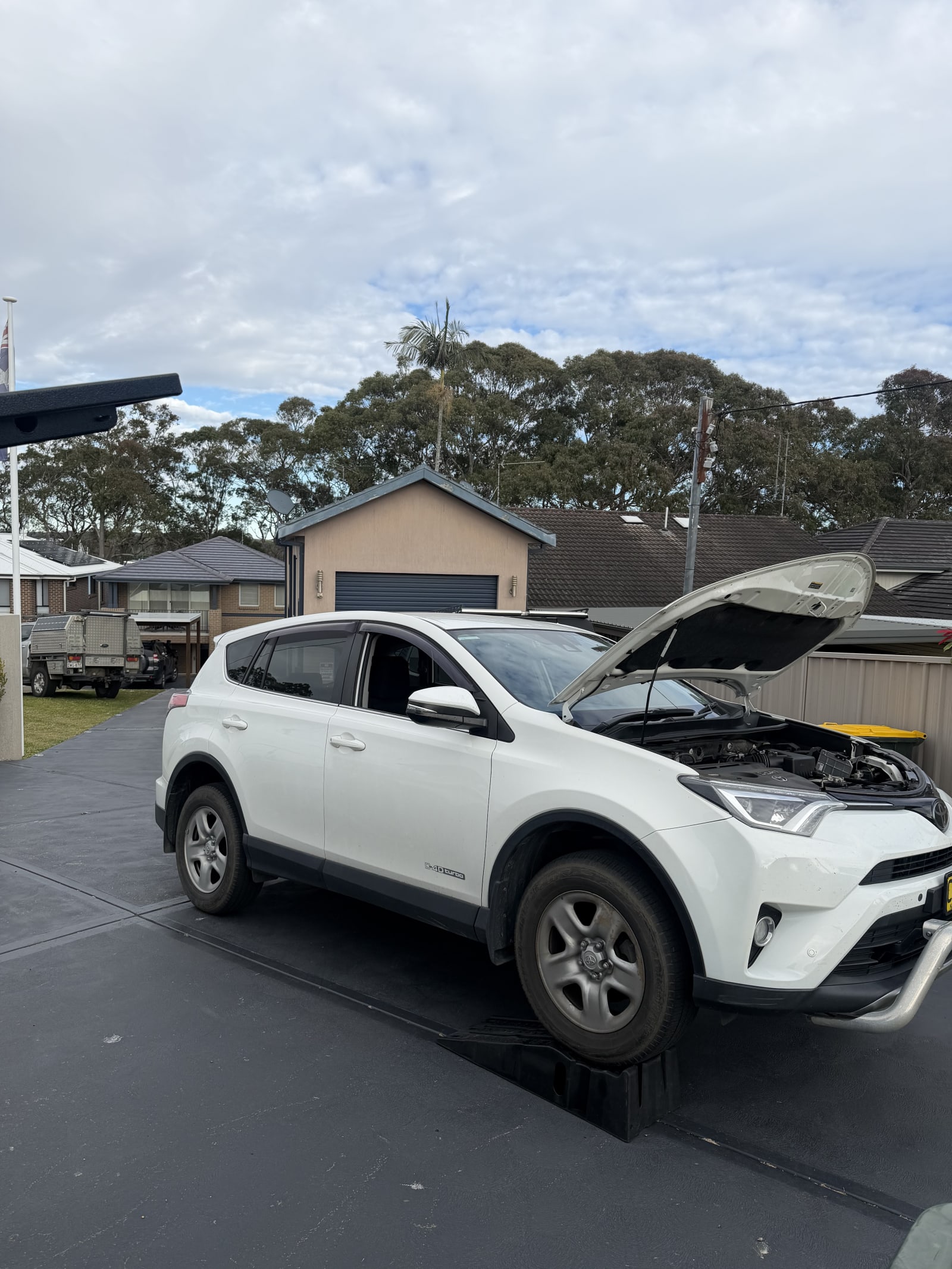
A mobile service does not. The car stays in the driveway at Lisarow or in the work car park at Gosford, and the work happens around it. For anyone whose day does not have a spare half in it, that is the whole point.
There is a second, quieter cost to the dealer default. A car that only ever goes back to one place tends to get quoted as a package, and the owner never sees the line items separately. When the servicing sits with someone who has to itemise it, the difference between what the schedule requires and what was suggested on the day becomes visible, and you get to decide about the second one.
One thing we do not do
We are straight about scope. We do not take on auto electrical work. If a fault turns out to be electrical rather than mechanical, we will tell you that rather than chase it, and you will not be paying us to learn it on your car.
If a claim is ever refused for the wrong reason
This is uncommon, and it is worth knowing the shape of it anyway, because the moment it happens is the worst moment to be reading up on your rights.
Ask for the refusal in writing and ask for the specific reason. "It was not serviced by us" is not a reason on its own, and a written answer forces the real one into the open. If the real reason is that the schedule was missed or the wrong parts were used, that is a legitimate position and your invoices will settle it either way.
Then separate the two rights again. A manufacturer warranty is the manufacturer's own promise on their own terms. Consumer guarantees are separate, automatic, and cannot be excluded, and a fault that makes the car unfit for purpose or not of acceptable quality engages them whether or not a warranty applies. That is the ground worth standing on, and it is why keeping the invoices matters more than keeping the stamps.
The ACCC's page on warranties sets out the difference plainly, and the industry advice is to raise it with the ACCC directly if a claim is declined purely because a dealership did not do the servicing.
Where to start
Open the logbook and find the next interval and what it calls for. If a line in there says the car must be serviced by an authorised dealer to keep the warranty, read it against the ACCC's own guidance before you accept it as a rule.
Then decide on the schedule rather than the address. If you are not sure when the next one is actually due, the two limits in your logbook explains which of them usually runs out first here.
We do logbook servicing, general servicing and mechanical repairs across the Central Coast, and we come to you. Get in touch for a quote.